Parents helping primary-school children recognise Chinese characters, especially when moving between learning material from China and Singapore.
Choose a region and grade without assuming the lists are equivalent
In Chinese-learning mode, open the character and word module, then select a region and collection. China’s Grade 1 and Singapore’s Primary 1 may share characters, but this does not make their coverage or teaching order identical.
Use the collection matching the child’s current course as the main sequence, and another collection as supplementary material. For a familiar character, check whether the child can pronounce it, recognise it and use it in a word before deciding how much practice it needs.

Connect meaning with the picture, then look at the character
Open a character card. Look at the character and its illustration, listen to the pronunciation, and check the pinyin. Ask the child to describe what is in the picture, then bring their attention back to the written form.
For 木, first connect the character with a tree or wood, then examine its shape. For an abstract character or one with several meanings, a picture provides only one clue. Explain it in a word or sentence rather than treating the image as a complete definition.
Reusing the same picture for a character across collections keeps that visual cue consistent. To check recognition, also ask the child to identify the character without the picture.
Watch the stroke order, then trace it yourself
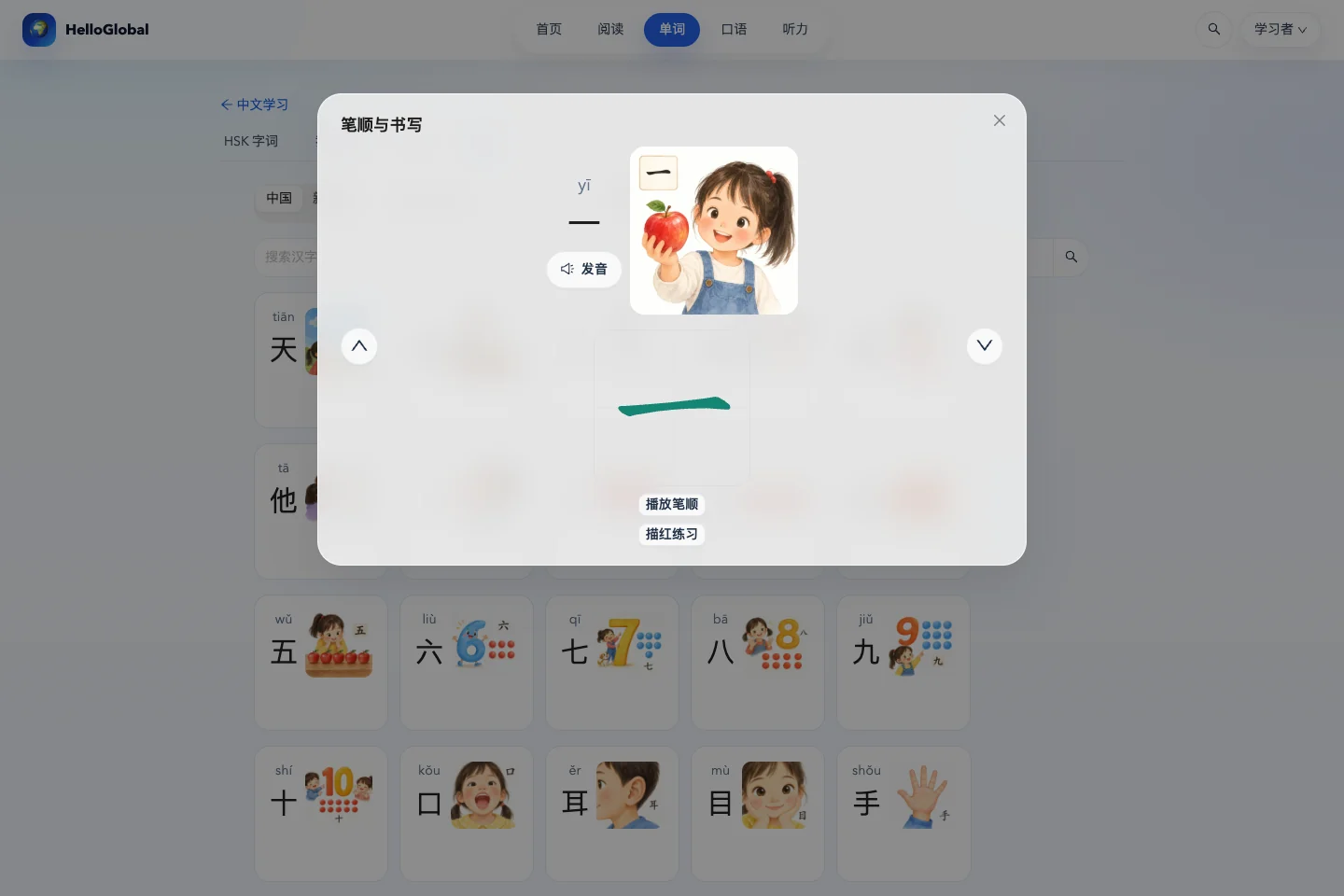
The Stroke order and writing dialog includes pronunciation, stroke-order playback and tracing. Watch the complete sequence first, notice the direction of each stroke, then try tracing it.
If the child needs more time, replay the animation and focus on a confusing stroke before moving on. After practising on screen, they can also try writing independently on paper.
The upward icon on the left moves to the previous character; the downward icon on the right moves to the next. Navigation follows the current list or search results. Pinyin, the picture and the writing area update together, so there is no need to close and reopen the dialog for every character.
Record what is familiar and plan the next review
After browsing, enter character-recognition practice. Look at the form and try saying its pronunciation and a word containing it. Listen to the audio if needed. Mark whether you know the character, then return to unfamiliar ones for more practice.
Try a small group: recognise, listen, write, then mix up the order and identify the characters again. This is a possible home practice routine, not a requirement for every child to learn at the same pace.
After changing the region, grade or search terms, check the current list before continuing to navigate. This helps you keep track of which set of characters you are reviewing.
Frequently asked questions
Why does a character have the same picture in different collections?
Character illustrations can be shared. The collection determines which characters appear and in what order; it does not need a separate copy of the same illustration for every occurrence.
Does watching the stroke animation mean a child can write the character?
The child still needs to try. Start with tracing, then write on paper without prompts, and finally check for missing strokes or mistakes in the order.